
 Call us now:


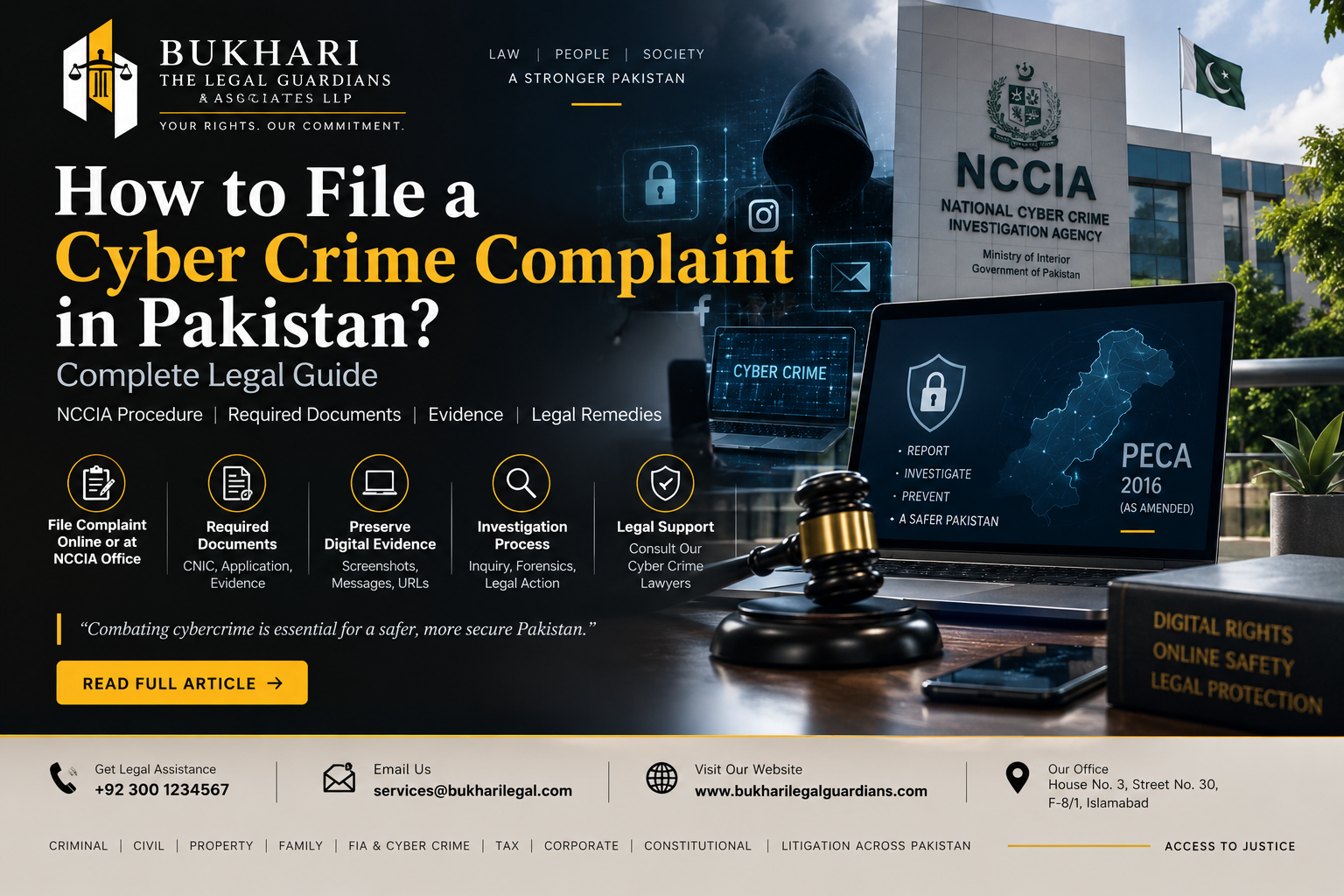
How to File a Cyber Crime Complaint in Pakistan | NCCIA Procedure, Evidence and Legal Remedies
Cybercrime has become increasingly common in Pakistan. People may face online harassment, blackmail, impersonation, hacking, unauthorized access, online fraud, identity theft, threats, privacy violations and other offences involving electronic systems or social media.
For victims, one of the most important questions is: Where should a cybercrime complaint be filed in Pakistan, what evidence is required, and what happens after the complaint is submitted?
This guide explains the current procedure for reporting cybercrime in Pakistan, including the role of the National Cyber Crime Investigation Agency (NCCIA), required documents, online complaint registration, the importance of preserving digital evidence and the legal remedies that may be available.
What Is Cybercrime in Pakistan?
Cybercrime generally refers to unlawful conduct involving computers, mobile phones, electronic systems, digital communications, social media or other information and communication technologies.
Depending upon the facts, matters may involve offences relating to:
- Online harassment
- Cyberstalking
- Online blackmail
- Unauthorized access to accounts or systems
- Hacking
- Identity theft or impersonation
- Online fraud
- Electronic forgery
- Privacy violations
- Threatening or abusive online communications
- Unauthorized transmission or disclosure of information
- Other offences falling within the applicable provisions of the Prevention of Electronic Crimes Act, 2016 (PECA) and other applicable laws.
The exact legal provision depends upon the conduct involved and the evidence available.
Which Agency Handles Cybercrime Complaints in Pakistan?
This is an important change for anyone searching for information about cybercrime complaints in Pakistan.
The National Cyber Crime Investigation Agency (NCCIA) is currently the relevant specialized law-enforcement agency for cybercrime matters. The NCCIA states that, following the 2025 amendment to PECA, it is authorized under Section 29(1) to conduct inquiries, investigations and prosecutions relating to offences under the Act.
Therefore, older internet articles referring exclusively to the FIA Cyber Crime Wing may not accurately describe the current institutional arrangement.
How Can You File a Cyber Crime Complaint?
The NCCIA currently provides several routes for reporting a cybercrime.
Online Complaint
A complainant can submit a complaint through the NCCIA’s online complaint portal.
The online form asks for information including:
- Full name
- CNIC
- Gender
- Mobile number
- Email address
- Occupation
- Postal address
- City
- Crime category
- Details of the alleged cybercrime
The complainant must also complete the verification/captcha and affirm that the information provided is correct.
Can You Visit an NCCIA Office?
Yes.
The NCCIA advises complainants that a formal complaint for investigation can be pursued through the nearest Cybercrime Reporting Centre (CCRC).
For Islamabad, the NCCIA currently lists its Islamabad office at:
Plaza 5/C, Street No. 169, G-13/3, Islamabad
The listed contact number is +92 51 9262106.
The NCCIA also lists 1799 as its contact/helpline number.
What Documents Are Required?
According to the NCCIA’s current FAQ, the basic documents required include:
Written application:
A written complaint containing the complainant’s name, address, city and contact details.
CNIC:
A copy of the complainant’s CNIC.
Evidence:
Copies of the relevant evidence relating to the alleged cybercrime.
Depending upon the circumstances, additional information or material may be requested during the inquiry or investigation.
What Evidence Should You Preserve?
Digital evidence can be extremely important in cybercrime proceedings.
If someone is threatening, blackmailing, impersonating or defrauding you online, do not immediately delete the messages or account information.
Preserve, where available:
- Screenshots of messages
- WhatsApp conversations
- Facebook/Instagram/TikTok profiles
- Profile URLs
- Phone numbers
- Email addresses
- Email headers where relevant
- Transaction records
- Bank receipts
- Easypaisa/JazzCash records
- Audio or video files
- Threatening messages
- Photographs
- Website links
- Account usernames
- Dates and times of communications
- Relevant devices or storage media
It is also important to preserve the original electronic material, not just edited screenshots.
The NCCIA states that its functions include digital forensics, including retrieving, preserving and analysing electronic data for investigations and legal proceedings.
What If Someone Is Blackmailing You Online?
Online blackmail is a serious situation and should not simply be ignored.
For example, a person may threaten to:
- Publish private photographs;
- Share personal information;
- Send material to family members;
- Publish content on social media;
- Create fake accounts;
- Contact an employer;
- Demand money;
- Demand further photographs or information.
In such circumstances, the victim should preserve the communications and relevant account information and consider making a complaint to the NCCIA.
The NCCIA specifically provides information concerning cyber harassment and identifies reporting channels including its complaint portal and helpline.
What If Someone Creates a Fake Facebook or Instagram Account?
Impersonation through social media can create serious legal and practical problems.
A victim should preserve:
- The fake profile URL;
- Screenshots;
- Username;
- Profile photographs;
- Messages sent from the account;
- Posts published by the account;
- Details of people contacted by the impersonator; and
- Any other information that may assist investigators in identifying the person responsible.
The complaint should clearly explain why the account is fake, how it is being used and what harm or unlawful conduct has resulted.
What If You Lose Money Through an Online Scam?
Online financial fraud should be documented immediately.
Preserve:
- Bank transaction statements;
- Account numbers;
- Transaction IDs;
- Screenshots;
- WhatsApp conversations;
- Phone numbers;
- Social media profiles;
- Emails;
- Websites used by the alleged fraudster;
- Payment receipts; and
- Any advertisements or investment proposals.
The NCCIA’s cybercrime information also identifies various forms of online financial fraud, including click fraud and fraudulent messages designed to obtain personal credentials.
Where money has been transferred through a bank, mobile wallet or other financial service, the victim should also consider promptly contacting the relevant financial institution regarding the transaction.
Can an Overseas Pakistani File a Cybercrime Complaint?
Yes, the NCCIA provides a procedure for overseas complainants.
According to the NCCIA, a person living outside Pakistan can nominate a focal person in Pakistan, such as a relative or legal counsel, to pursue the matter at a Cybercrime Reporting Centre.
The NCCIA states that the focal person’s name, city, contact number, postal address and CNIC details are required.
This can be particularly relevant to overseas Pakistanis facing online harassment, fraud, impersonation or other cyber-related offences connected with Pakistan.
What Happens After Filing a Cybercrime Complaint?
The precise process depends upon the allegations and available evidence.
Generally, the complaint may be examined to determine:
First, whether the allegations fall within the applicable cybercrime jurisdiction.
The agency may assess the nature of the conduct and the information provided.
Second, the evidence may be examined.
Digital communications, transaction information, account details and other electronic material may be relevant.
Third, an inquiry or investigation may follow where legally warranted.
The NCCIA describes its functions as including cyber investigation, digital forensics and prosecution.
Fourth, further legal proceedings may follow depending upon the evidence and applicable law.
The precise outcome will depend upon the facts, applicable statutory provisions and investigative findings.
Should You Delete the Messages After Filing a Complaint?
Generally, you should preserve the original evidence.
Do not assume that screenshots alone are sufficient in every case.
If possible, retain:
- The original phone;
- Original conversations;
- Original emails;
- Original files;
- Original photographs/videos;
- Account information; and
- Other electronic records.
Avoid unnecessarily altering, editing or deleting the material.
Can a Lawyer Help With a Cybercrime Complaint?
Yes.
A lawyer may assist in:
- Preparing the complaint;
- Identifying the potentially applicable legal provisions;
- Organizing digital evidence;
- Preparing a chronology of events;
- Communicating with the investigating agency;
- Responding to notices;
- Protecting the complainant’s legal interests;
- Advising an accused person during an investigation;
- Seeking appropriate relief before the courts; and
- Handling bail or other court proceedings where a criminal case has been initiated.
However, the legal strategy depends heavily upon whether the person is the complainant, accused or another affected party.
Contact Bukhari the Legal Guardians
What Should You Do If You Receive an NCCIA Notice?
Do not ignore an official notice.
The recipient should first understand:
- The nature of the complaint;
- The allegations;
- The legal provision mentioned;
- The documents or information requested;
- The date and place of appearance; and
- Whether legal representation is appropriate.
A lawyer can review the notice and advise on the appropriate response.
Cybercrime Complaint in Islamabad
For people located in Islamabad, the NCCIA currently lists an Islamabad office at Plaza 5/C, Street No. 169, G-13/3, Islamabad, with telephone number +92 51 9262106.
The NCCIA also provides its online complaint portal, which can be used to submit complaint information electronically.
Frequently Asked Questions
How do I file a cybercrime complaint in Pakistan?
You can submit a complaint through the NCCIA online complaint portal, contact the NCCIA through its designated channels, or visit the relevant Cybercrime Reporting Centre.
Is cybercrime handled by NCCIA?
Yes. The NCCIA states that under Section 29(1) of PECA as amended in 2025, it is the authorized law-enforcement agency for inquiries, investigations and prosecutions under the Act.
What evidence is needed for a cybercrime complaint?
The NCCIA identifies a written application, CNIC copy and evidence as basic requirements. Depending on the case, additional material may be required.
Can I complain about WhatsApp blackmail?
Potentially, yes. The facts and communications should be documented and reported through the appropriate cybercrime channel.
Can an overseas Pakistani file a complaint?
Yes. The NCCIA provides for an overseas complainant to nominate a focal person in Pakistan to pursue the matter.
Conclusion
Cybercrime complaints require prompt action, accurate information and preservation of digital evidence. Whether the matter involves online harassment, blackmail, impersonation, hacking, fraud or another electronic offence, the complainant should document the incident carefully before submitting the complaint.
Under the current framework, the National Cyber Crime Investigation Agency (NCCIA) is the relevant specialized agency for cybercrime inquiries, investigations and prosecutions under PECA.
For serious matters, particularly where there are threats, financial loss, sensitive personal material, an NCCIA notice, arrest risk or an ongoing investigation, obtaining legal advice at an early stage can help ensure that the complaint or response is properly documented and that the person’s legal rights are protected.
Need Legal Assistance With a Cyber Crime Matter?
If you are facing online harassment, cyber blackmail, online fraud, impersonation, hacking, an NCCIA inquiry or notice, or another cybercrime matter in Pakistan, professional legal assistance can help you understand the applicable provisions of PECA, organize digital evidence and determine the appropriate legal course. Bukhari, The Legal Guardians & Associates LLP, based in Islamabad, provides legal assistance in cybercrime, PECA, criminal defence, FIA/NCCIA matters and related litigation before the relevant authorities and courts in Pakistan. Contact our lawyers for case-specific legal guidance. Contact Us Now
Disclaimer: This article is provided for general legal information and does not constitute legal advice. The applicable law and procedure depend upon the facts of each individual matter.